Consider this scenario.
A stolen login and a legitimate one clear the same checkpoint. Once credentials pass, most security programs stop watching, and everything that happens next in a production environment goes unrecorded until someone comes looking after the fact.
This is a serious identity blind spot.
Authentication is a checkpoint, not a camera: confirming who's walking through the door, enforcing MFA, validating the login. What happens on the other side of that door is a different question, and that’s where most security tools run out of visibility.
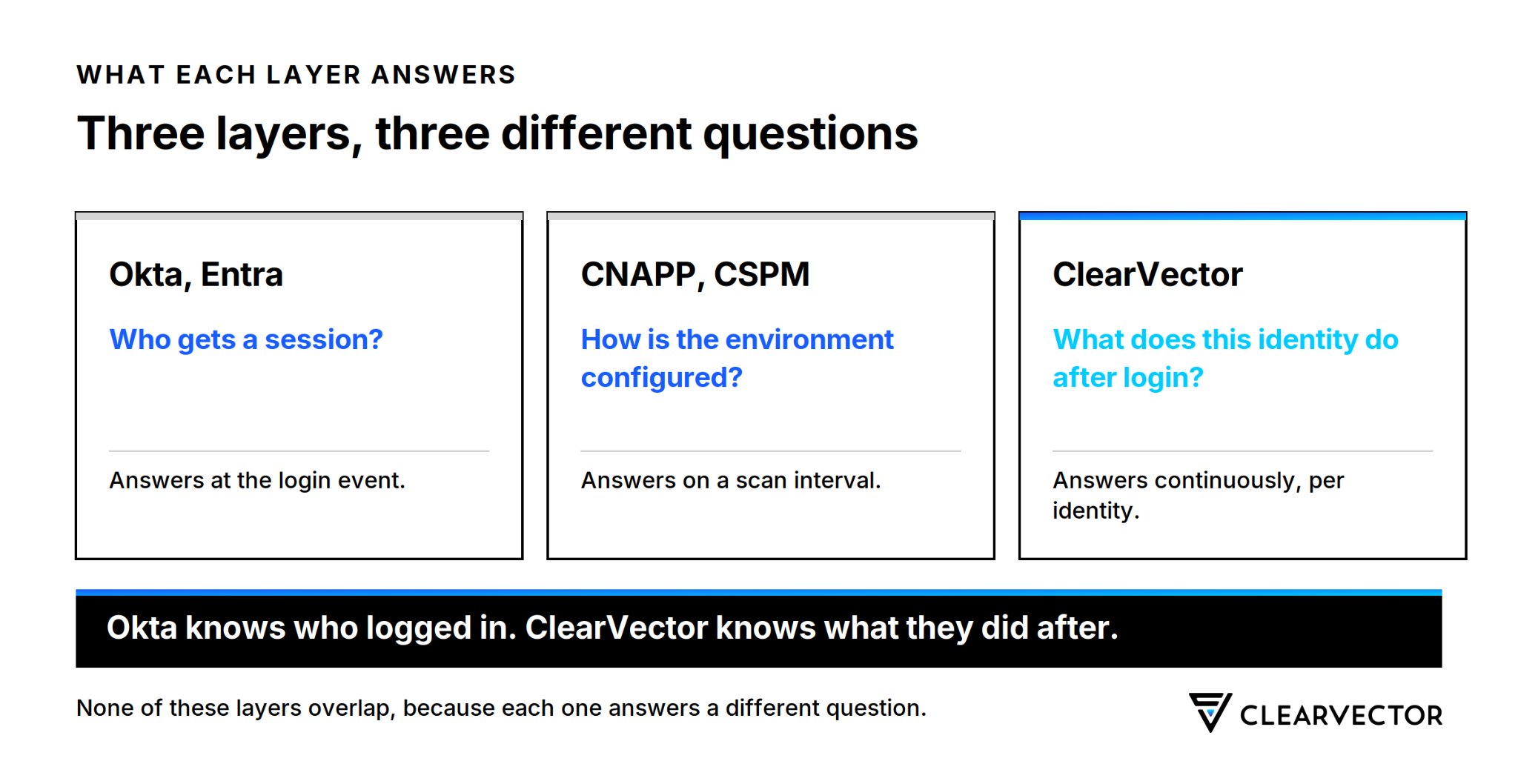
After authentication, most environments lose the thread: which roles that identity assumes, which resources the identity reaches, and whether those actions fit established patterns. None of this information gets recorded for the environment - not because there’s a lack of investment, but because the existing tools were designed to verify access, not explain behavior. See Visual 1 for the comparison.
The tools you have were built for a different surface
Every action inside an AWS, GCP, or Azure production environment traces back to an authenticated identity: a container pulling a secret, a script rotating a key, a contractor connecting to a data pipeline, or an AI coding agent pushing a change under someone else's login. Nothing happens anonymously once a credential is involved. The activity just happens - unwatched.
- Enterprise IdPs like Okta, Entra, and others do their job well: deciding who gets a session in the first place. These providers do not follow that session into production to see what happens once the session goes live.
- Endpoint security covers a different footprint: laptops, phones, managed devices. Production doesn't have a laptop to protect - traditional EDR tools are not aware of the control plane, service accounts, or the workload identities - and focus on the TTPs of the adversary.
- CNAPP, CSPM, SIEM, and UEBA tools are each built for a specific problem. Configuration and vulnerability management tools scan for misconfigurations and attack paths: a misconfigured bucket, a role with too much reach, or a path an adversary could take. SIEM and UEBA tools work from collected logs. None of these tools watch what a specific identity does at runtime after a successful login. They run on scheduled scans or require normalized log ingestion, so a resource can look clean at 9am and 5pm and still have been accessed, changed, and cleaned up in between. The scan never caught the change, because the scan wasn't running at 1pm.
None of these tools are failing at their job. Each was built for one specific problem, and each solves that problem well. Watching what a specific identity does after login was simply never one of those problems.
Who’s running your environment? Probably not who you think.
Ask most security teams to describe their identity population, and they'll describe people: employees, contractors, admins. That picture covers a shrinking share of what's actually active inside a production AWS or GCP environment on any given day.
The rest of that population is made up of machine and workload identities: service accounts, workload identities, Kubernetes service accounts, third-party integrations, AI agents running under someone else's credentials. Many operate continuously, authenticate at all hours, and exist without an accountable owner listed anywhere in the organization's IAM system.
A backup script running its nightly job and an adversary stealing data under a stolen credential generate the same kind of log entry: valid authentication, an action inside the account's permitted scope, and no notification. The credential doesn't distinguish between the two. And neither does a system built only to check whether the credential is valid.
This is the actual shape of the problem: a compromise using a valid credential doesn't look like a break-in, because on paper, the access looks legitimate. Catching that early depends on knowing in advance what normal looks like for a specific identity in a specific environment - not on waiting for a notification that was never designed to fire.
Why are AI agents and non-human identities harder to monitor after authentication than human users?
According to our upcoming report, non-human identities now outnumber human identities by a significant margin in cloud-native environments. AI agents are operating in production under human service account, and other identities, executing multi-step workflows- with no designated owner and no behavioral model in effect. Both human and non-human populations were already active before most security programs adapted to account for either one.
At the same time, AI agents are now operating in production using human or service account credentials, executing multi-step changes with the full access those credentials provide. A 2026 survey of large-enterprise security leaders (Cybersecurity Insiders/Saviynt) found that most of the participating organizations don't have full visibility into their AI agent identities, and most doubt they could catch or contain a compromised identity right now.
Neither trend is a future problem. Both are already running in most production environments right now, unmonitored, because the tools built to watch authentication were never built to watch what happens after a successful login.
The cost of that blind spot isn't theoretical. IBM's Cost of a Data Breach 2024 report puts average dwell time for a credential-based attack at 292 days, at a cost of $32,191 for every day an adversary operates before anyone notices.
What we're publishing next
We’ve been building a model from within real production environments to answer a simple question: What is actually operating in your environment, and does that activity match what a security team would expect? The findings are more specific - and more unsettling - than most security teams anticipate.
We’re publishing the full ClearVector Identity Intelligence Report next week. Free, ungated, and built for security practitioners, it offers a data-driven look at the identities inside modern environments - and how far that reality can drift from what organizations think they understand.
Want to see what's actually operating in your production environment before the report lands?
A Breach Readiness Report takes 15 minutes. We map your production identity universe and show you the top exposures an adversary could act on today.
Request a Breach Readiness Report

%201.avif)