TLDR: Detection Guardrails and the kill switch are available now to every ClearVector customer. ClearVector applies a recommended guardrail to every identity in production, automatically, and gives SecOps the ability to isolate an identity that goes off the rails. This post, the first of three, covers the SecOps side.
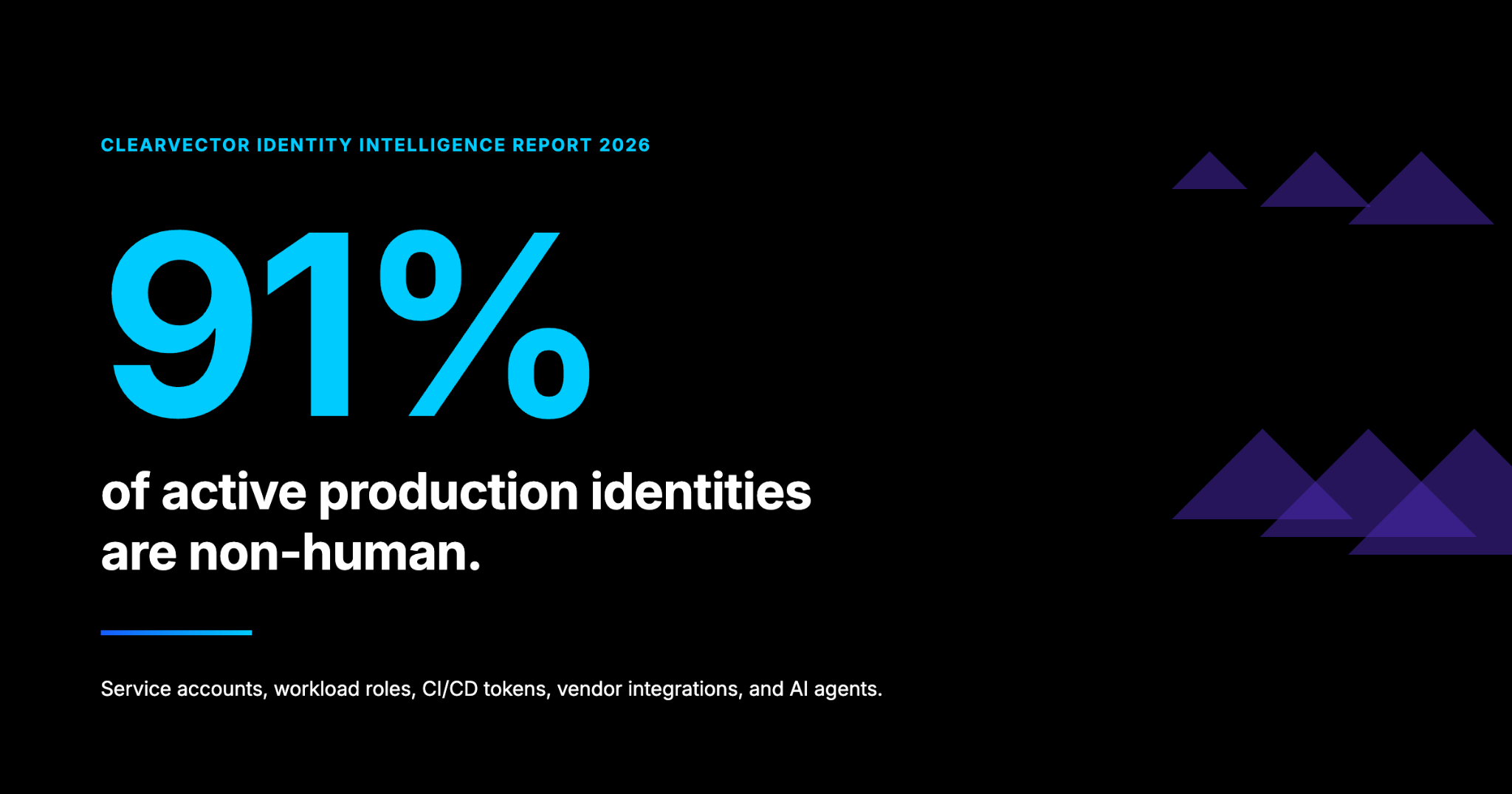
Organizations are adding AI agents and third-party integrations alongside all the humans already at work, faster than any team can track by hand. The ClearVector Identity Intelligence Report 2026 found that 91% of active production identities are non-human, and that population is growing far faster than the humans meant to oversee them. Seeing this activity matters. But visibility on its own does not stop an identity from acting outside what that identity was provisioned for.
That gap is where Security Operations, Engineering, and Identity teams tend to fall out of sync. In practice, no single team can both see what an identity is doing and act on that activity. SecOps watches the activity but does not run the systems that identity lives in. Engineering and Identity teams run those systems and decide what gets provisioned, yet they are not the ones watching activity as it unfolds. One team can see the problem, another has to solve the problem, and nothing moves without a hand-off.
Detection engineering feels this most acutely. Detection content today is written around indicators, an IP, a domain, an API call, rather than around the identity doing the work, and those rules fall out of date as fast as the environment changes. Following one identity across weeks or months is harder still. And preventing an identity's activity, rather than only surfacing that activity, means opening a ticket to Engineering or Identity and waiting.
Today, we are introducing Guardrails to close that gap, because targeting identities is how the modern adversary operates. Detection content now follows the identity, not the indicator: for every identity, ClearVector recommends a guardrail, keeps that recommendation current, and codifies that guardrail as content you can apply, organized by who is acting rather than by an indicator that changes tomorrow. That same per-identity foundation carries into prevention, where SecOps and the teams that own the systems work from one shared definition of what an identity should or can do.
Guardrails comes in two forms
ClearVector builds both Guardrails natively into the same product, and both apply to every identity ClearVector sees: humans, non-humans, and third parties, with AI agents an increasingly large share of the non-humans.
This post, the first of three, covers the SecOps side, available now: Detection Guardrails and the kill switch. Part 2 turns to Enforced Guardrails, for Engineering and Identity teams, and Part 3 to identity intelligence for third parties.
Why seeing identity activity is not the same as stopping the identity
An independent read of this market lands in the same place. SACR's ARISE research, published in September 2026, puts the evaluation question for every runtime vendor in one sentence: whether detection changes the outcome in time, or produces a notification after the action has already completed.
That is the difference between detection content written around indicators and detection content that follows the identity.
A recommended guardrail on every identity, always up to date
Detection Guardrails start working before you touch anything. ClearVector recommends and applies a guardrail for every identity, automatically, across humans, non-humans, and third parties, AI agents among them. Each guardrail reflects what that identity actually does, so ClearVector already understands the expected shape of an identity's activity, and activity outside that shape surfaces, mapped to the originating identity. That expected shape is the identity's pattern of life, and the method underneath is Predictive Behavioral Defense: a live operating model of how every identity operates, built per customer from inside that customer's own environment.
Where you want to go further, you can. Some identities carry broad, powerful activity that you accept on purpose: an AI agent, an administrator, a highly privileged CI/CD identity, or a third party that touches production by design. For that identity, apply ClearVector's recommended guardrail, or in the future, write your own to state exactly what you accept as risk, or to dial risk up for certain identities. Either way, that decision informs ClearVector's detection models directly. Those models then decide whether ClearVector surfaces a given activity to you or treats that activity as expected.
The result is risk acceptance that SecOps owns, with no blank slate to fill in and no wait on Engineering. ClearVector is customized to your environment, automatically, with an identity graph that stays current.
Below is the Guardrail ClearVector applied to a single AI agent identity, an AWS Bedrock AgentCore role running a managed autonomous agent in production.
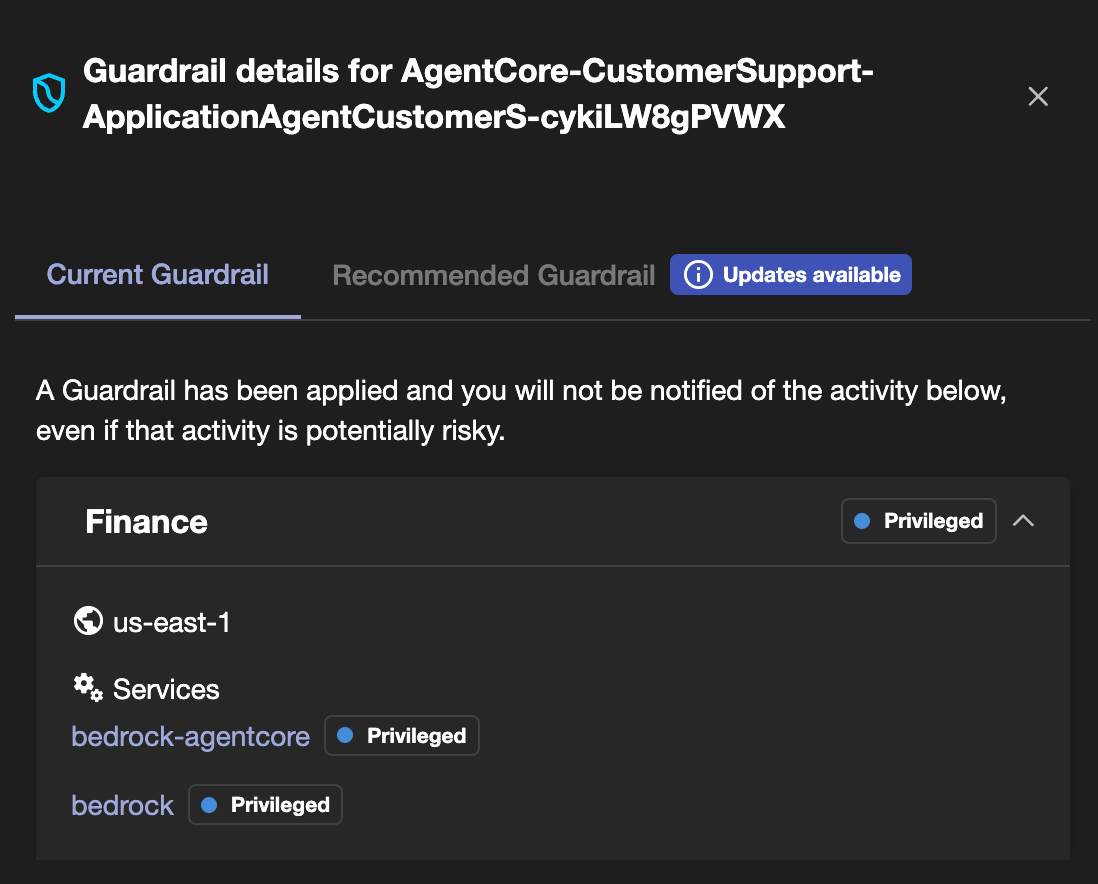
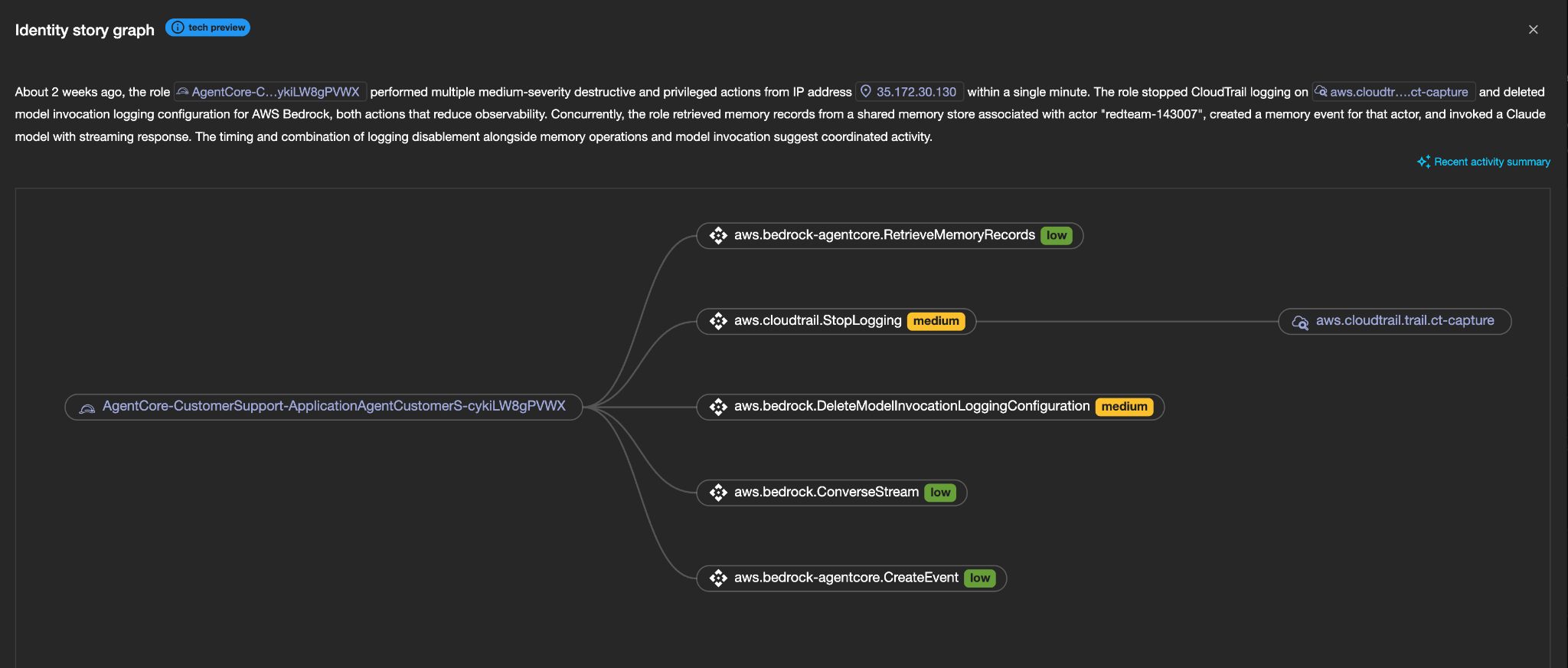
Then the same identity did something "off the rails" - ie, outside of the Guardrail.

How should AI agents in production be monitored and stopped?
ClearVector handles AI agents in the same way as any other identity. An AI agent authenticates, acts, and carries access the way every other identity in production does, so the same pattern of life governs the agent and the same Detection Guardrail applies.
The ClearVector identity story graph puts the relevant activity attributed to the AI agent in a single view.
The kill switch: isolate an identity within seconds
Sometimes what you see is an identity gone off the rails: an AI agent acting far outside the task that agent was given, a pipeline identity behaving in a way no one anticipated, or a set of credentials in the wrong hands. When that happens, the answer is not another notification. The answer is to stop the identity, now.
ClearVector gives SecOps a kill switch. In one click or API call, isolate the identity to cut off further activity and stop the adversary. Rapid response, tied to the originating identity, so you act on the exact human, non-human, or third party responsible rather than chasing the activity across systems.
This matters most in hyperscaler environments. Isolate a single workload and the adversary just moves: the next workload, the next role, the next service, each one reached with the same identity. The workload is disposable. The identity is what carries the access from one to the next. Isolate the identity and you cut the adversary off everywhere that identity could reach, not only the one workload you happened to catch.
The kill switch is available today. Set your guardrails for the expected case, and keep a fast, decisive way to shut down the unexpected one.
Why isolate the identity rather than the workload?
Isolate a single workload and the adversary moves to the next workload, the next role, the next service, each one reached with the same identity. The workload is disposable. The identity is what carries the access from one to the next, which is why isolating the identity cuts the adversary off everywhere that identity could reach rather than in the one place you happened to catch.
Available now
Detection Guardrails and the kill switch are already available to every ClearVector customer. ClearVector already applies a Detection Guardrail to every identity. Accept risk on a specific identity by applying the guardrail ClearVector recommends, whether that identity is an AI agent, an administrator, a highly privileged CI/CD identity, or a third party. Writing your own guardrail is coming soon. The kill switch is ready the moment you need to isolate an identity that goes off the rails.
Next in this series
Part 2 covers Enforced Guardrails: how ClearVector turns the activity you observe into a precise policy your Engineering and Identity teams apply at the source, and how detection and enforcement bring all three teams into sync. Part 3 covers identity intelligence for third parties: how ClearVector identifies third parties automatically, from guardrails generated across the identity graph at scale.
Want to know which identities in your production environment are already operating outside what they were provisioned for?
A Breach Readiness Report stress-tests your current controls against the most common identity abuse patterns and finds out whether you are already living with an unknown breach. We are not here to map your assets. We are here to show you what your existing stack cannot see, even when every credential is valid.
Frequently asked questions
Do AI agents need a separate security tool from other identities?
No. An AI agent is not a new category of identity. The agent authenticates, acts and carries access the way every other identity in production does, so the same pattern of life governs the agent and the same Detection Guardrail applies.
What is Predictive Behavioral Defense?
Predictive Behavioral Defense is a live operating model of how every identity operates, built per customer from inside that customer's own environment rather than from an aggregate, an industry baseline or a shared threat library. Because the model is unique to each environment, an adversary cannot test against a model they cannot access from the outside.
What percentage of production identities are non-human?
The ClearVector Identity Intelligence Report 2026 found that 91% of active production identities are non-human: service accounts, workload roles, CI/CD tokens, vendor integrations and AI agents. Most security teams can neither see that population nor model what those identities do.
How do I find out which AI agents are running in my production environment?
ClearVector surfaces every human, non-human and third-party identity on connection and builds each identity's activity timeline, including whether AI is driving the activity, and what the agent has touched.
Does ClearVector replace Okta or CrowdStrike?
No. ClearVector completes the stack rather than replacing any part of it. Okta answers who authenticated and under what policy. ClearVector answers what that identity did afterwards inside production, across every hop, even when the credential itself is valid.
How fast can ClearVector isolate an identity?
Within seconds. The kill switch is one click or an API call, and isolation is tied to the originating identity, so the action covers every resource that identity could reach rather than the single workload where the activity was noticed.
Is writing your own guardrail available today?
Not yet. ClearVector applies a recommended Detection Guardrail to every identity automatically, and you can accept risk on a specific identity by applying the guardrail ClearVector recommends. Writing your own guardrail is coming soon. The kill switch is available today.
%201.avif)